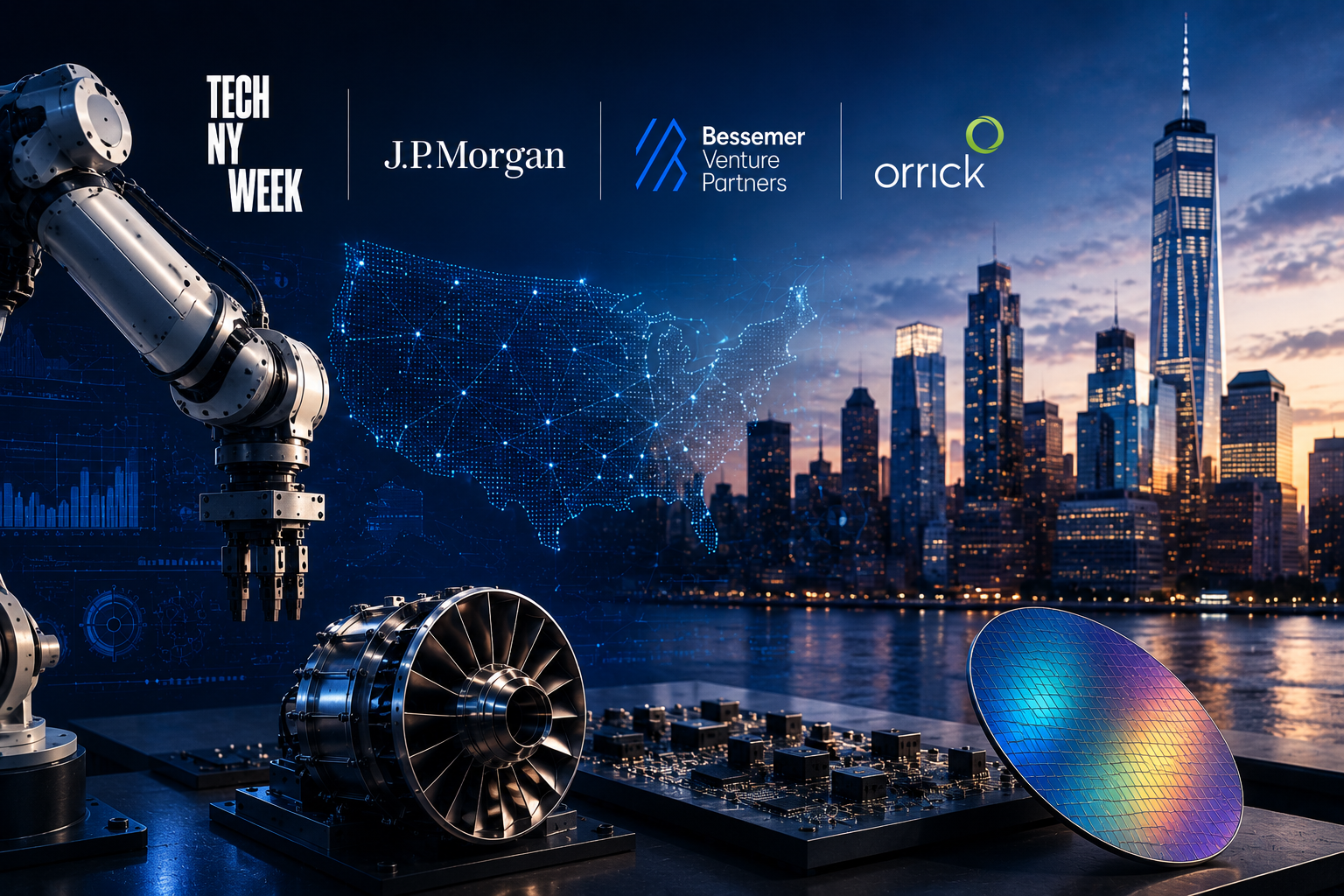
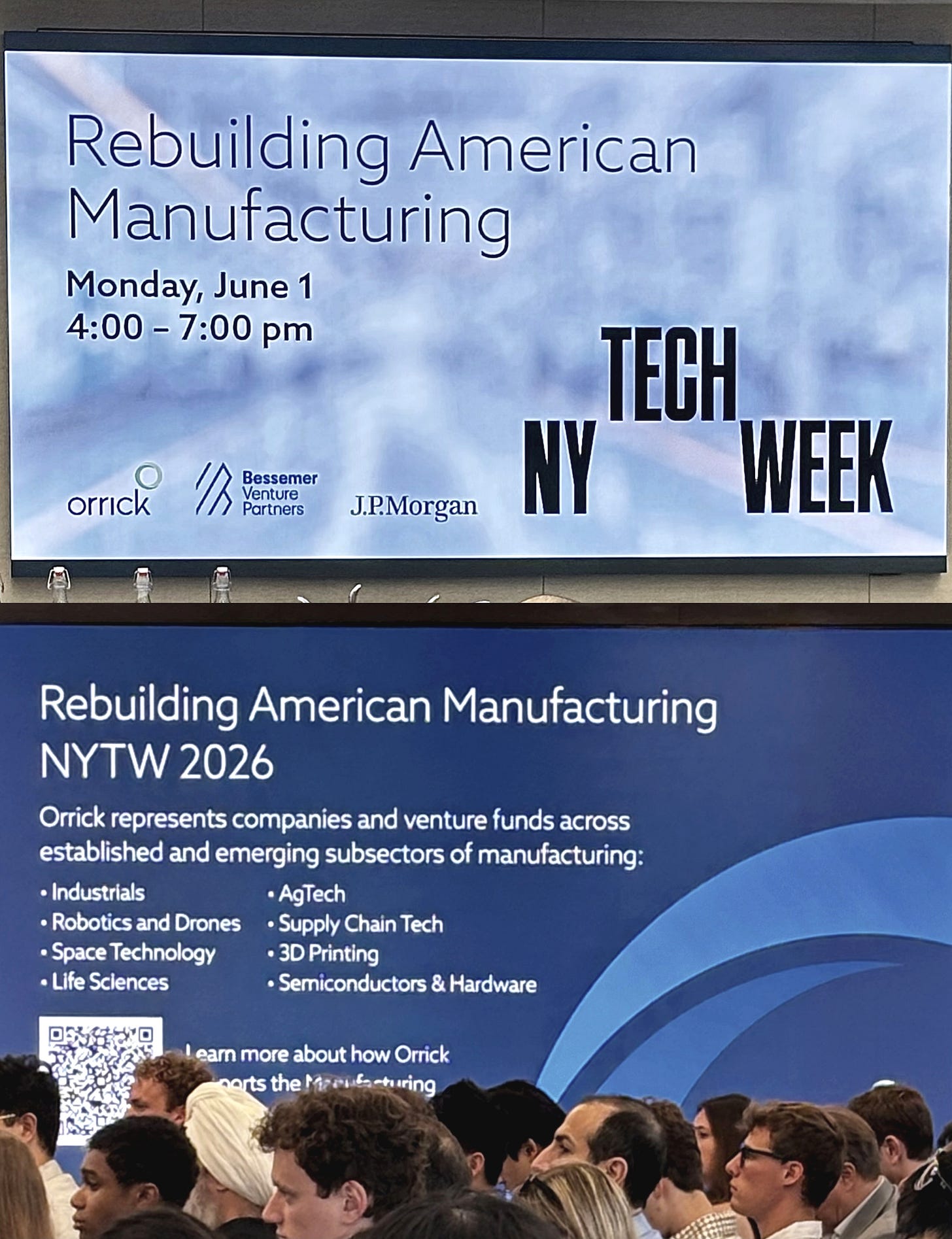
A panel titled "Rebuilding American Manufacturing" wasn't what I expected to leave New York Tech Week thinking about…
Hosted by JPMorgan, Bessemer Venture Partners, and Orrick, the room was packed with founders, investors, operators, and engineers. Yet the discussion quickly expanded beyond assembly lines to venture capital, artificial intelligence, industrial policy, supply chains, and national competitiveness.
By the end, I was left with a different question:
What does manufacturing actually mean in America today?
For many people, manufacturing still evokes images of assembly lines and factory floors. Manufacturing is often discussed as an economic challenge. Yet sitting in that room, it seemed equally like a cultural challenge.
People do not move toward industries because of policy papers. They move toward industries because of narratives.
Silicon Valley had the story of the garage founder. Wall Street had the story of ambition and meritocracy.
Manufacturing needs a new story.
Not one about assembly lines,
But one about creation.
One speaker argued that if America wants to rebuild manufacturing capacity, it must first make manufacturing culturally relevant again.
That observation stayed with me…
For decades, many of the most ambitious students were encouraged toward finance, consulting, software, law, and other white-collar professions. Success increasingly became associated with screens rather than physical production.
Yet nearly every challenge discussed during the panel — from energy infrastructure and semiconductors to aerospace and defense — depended on people willing to build things in the physical world.
The discussion also revealed how manufacturing sits at the intersection of politics, finance, and technology.
Politically, manufacturing has become tied to questions of national resilience, supply-chain security, energy independence, and strategic competition.
Technologically, advances in AI, robotics, automation, and industrial software are reshaping how products are designed and produced.
Financially, rebuilding industrial capacity requires enormous amounts of capital. Several speakers emphasized that factories, equipment, and infrastructure are financed differently from innovation itself. Machines can be financed with debt. New technologies often require equity. Scaling industrial businesses requires both.
Manufacturing is no longer a single industry.
It is an ecosystem.
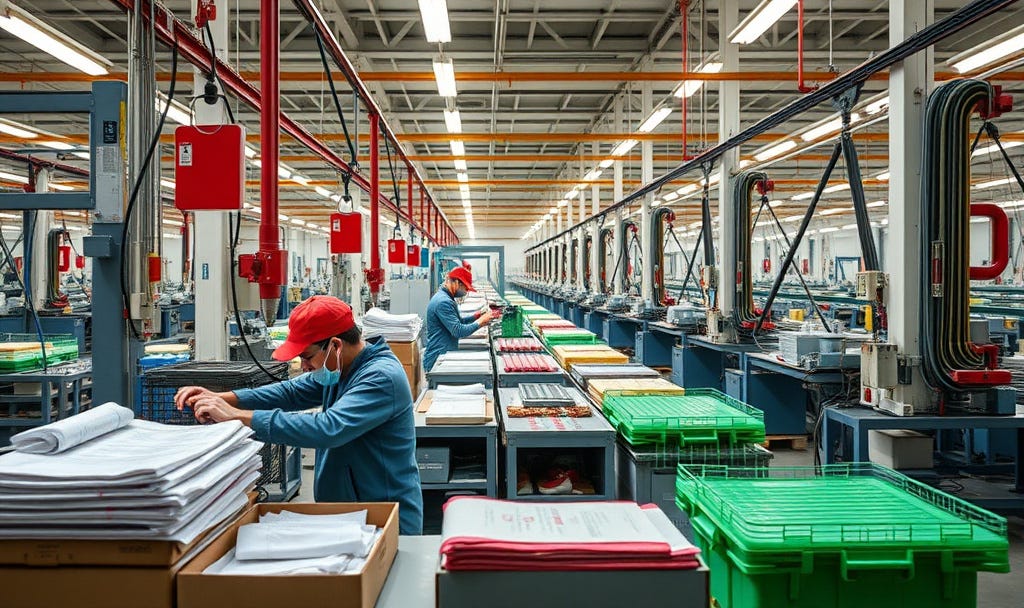
China appeared repeatedly throughout the discussion.
Much of China’s manufacturing strength was built through decades of scale, coordination, supplier density, and industrial investment. Several speakers noted the advantages created when an entire ecosystem grows together.
This raised a question I found myself returning to throughout the evening:
If China built manufacturing leadership through scale, what does manufacturing leadership look like for America?
Listening to the panel, the answer seemed less about mass production and more about producing differently — through specialized engineering, advanced technology, and complex systems that are difficult to replicate.
A factory still matters, but so do the software that tracks production, the engineers who improve workflows, the capital that finances growth, and the relationships that keep supply chains running.
The future of manufacturing may depend less on any single machine and more on how effectively these different pieces work together.
Thus, trust, certification, precision, and expertise become competitive advantages.
What surprised me most was that the conversation kept returning to the same word:
Scale.
Not scale in the traditional sense of producing millions of identical products, but scale as the ability to coordinate people, capital, technology, suppliers, customers, and information around a common goal.
A Boeing backlog is not merely a manufacturing problem — it is a coordination problem.
A supply chain is not merely a logistics problem — it is a coordination problem.
Even AI adoption, according to several speakers, is often less constrained by technology than by trust and organizational change.
The future factory may not be defined by robots replacing humans.
It may be defined by better systems helping humans work at larger scales.
When I entered the room, I thought the panel would be about rebuilding manufacturing. When I left, I wondered whether the real conversation was about redefining it.
Something new.
Because the future of manufacturing may not begin in a factory.
It may begin with convincing the next generation that building things is still worth aspiring to.
Stay curious,
Lorna :)